Tertiary Filtration
Run a tertiary filter with confidence: know what each filter type can catch, check its loading and backwash water with a calculator, read headloss and turbidity trends, estimate the phosphorus it removes, and keep it out of overflow on a storm day.
Who it is for
Operators at plants that have tertiary filters or are planning them, operators preparing for higher level wastewater certification exams, lab and maintenance staff who support filters, and managers weighing a filter project for a lower phosphorus limit.
Format
Online, self-paced: 10 timed modules with the manual reading, worked examples and a short check after each module, plus the student manual to download.
Length and price
2 hours, $70.
What you will learn
10 modules. Every example uses the fictional White River Resource Recovery Facility, a 10 MGD activated sludge plant planning cloth disk filters ahead of UV for a lower phosphorus limit, its plant water filters and its September 2026 operating data.
- Why tertiary filtration (12 min)What filters remove and what they cannot, where they sit, the White River filter plan and its September effluent.
- How filters catch particles (10 min)Straining, depth capture and attachment, surface and depth filters, particle sizes and why floc strength matters.
- Cloth disk and drum filters (12 min)The cloth disk flow path, pile cloth, level started backwash with suction shoes, tank solids, drum filters and daily checks.
- Dual media and multimedia filters (11 min)Anthracite, sand and garnet, gravity and pressure filters, the backwash sequence, bed expansion and media problems.
- Continuous backwash and deep bed filters (10 min)Upflow sand filters with an airlift and washer, air and reject control, deep bed and denitrification filters and bumping.
- Loading rates and filter math (15 min)Hydraulic loading, peak flow and units in service, solids load, UFRV, backwash water and percent removal.
- Headloss, run length and backwash (11 min)Clean and terminal headloss, the three backwash triggers, air binding and reading the run length trend.
- Turbidity, TSS and monitoring (10 min)Turbidity and TSS compared, a site correlation, turbidimeter care and what to trend each shift.
- Phosphorus polishing with filters (11 min)Particulate phosphorus, what a filter removes, a trim coagulant dose, the ortho analyzer and the path to 0.5 mg/L.
- Troubleshooting and safety (8 min)Troubleshooting guides, the September 2026 storm at White River, cloth cleaning chemicals and filter area safety.
What operators take away
- What tertiary filters remove, what they cannot, and how they catch particles.
- How cloth disk, dual media, continuous backwash and deep bed filters work, and what the operator controls on each.
- Filter math: hydraulic and solids loading, UFRV, backwash rate, volume and percent, bed expansion and percent removal.
- How to read headloss, run length and turbidity trends and set sensible backwash triggers.
- How much phosphorus a filter removes and how to size a small trim dose ahead of it.
- How to troubleshoot short runs, poor effluent, blinded cloth, mudballs and overflow, and work safely around filters.
- Timed online modules with a short check after each one, a final quiz that opens when every check is passed and the study time is logged, and a certificate of completion from Wastewater Academy™ when you pass it.
- A student manual to download (it comes with the class).
Look inside
A few sample pages from the student manual. Tap a page to open it full size.
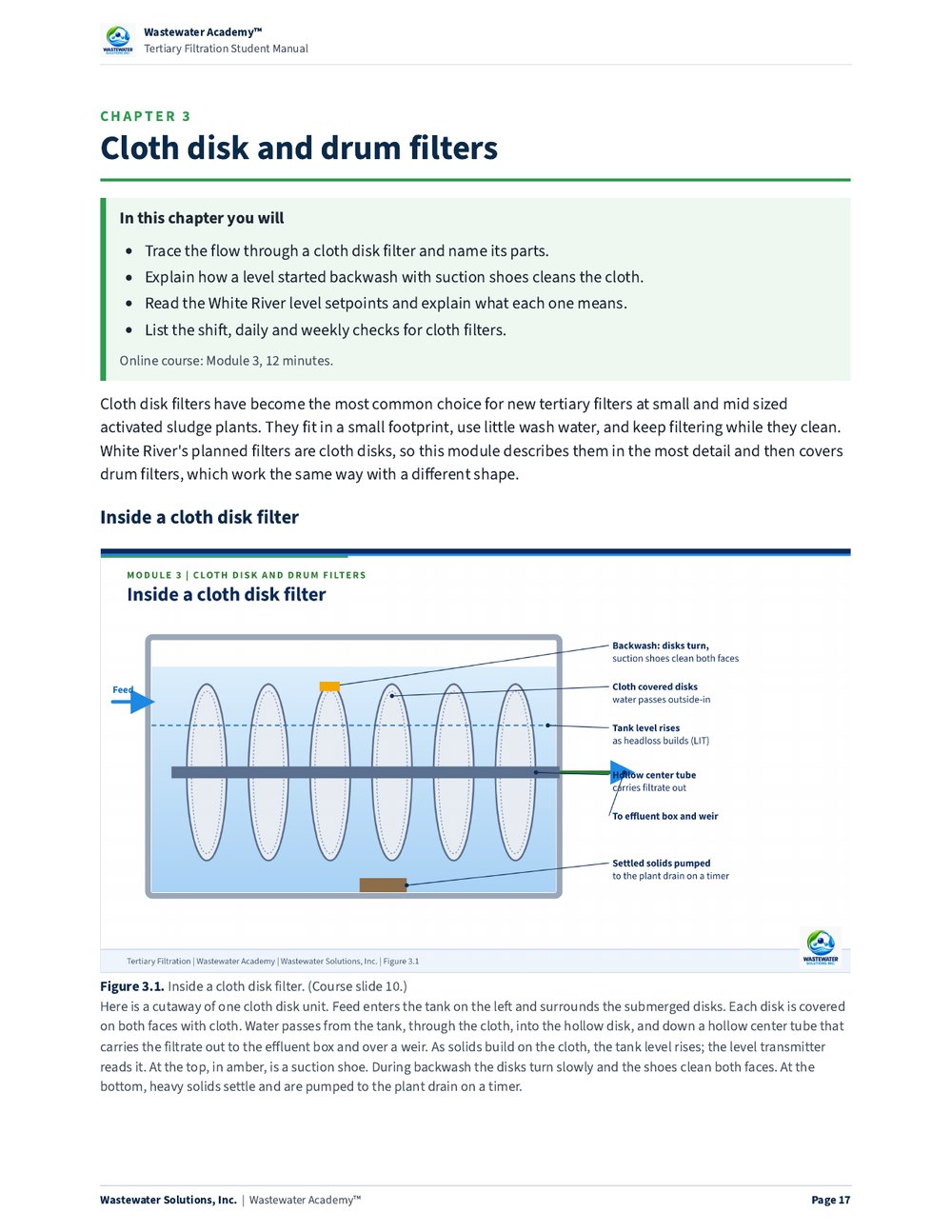
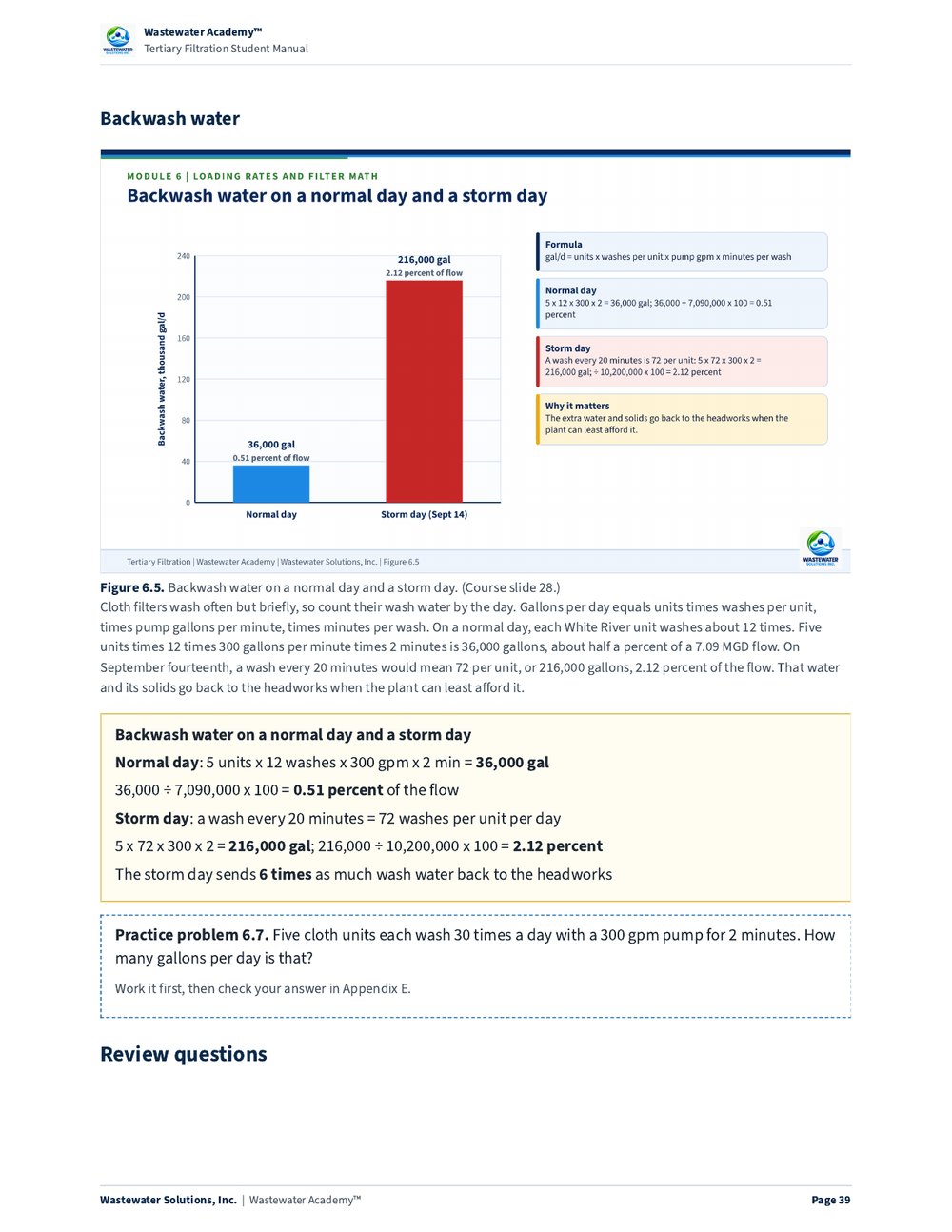
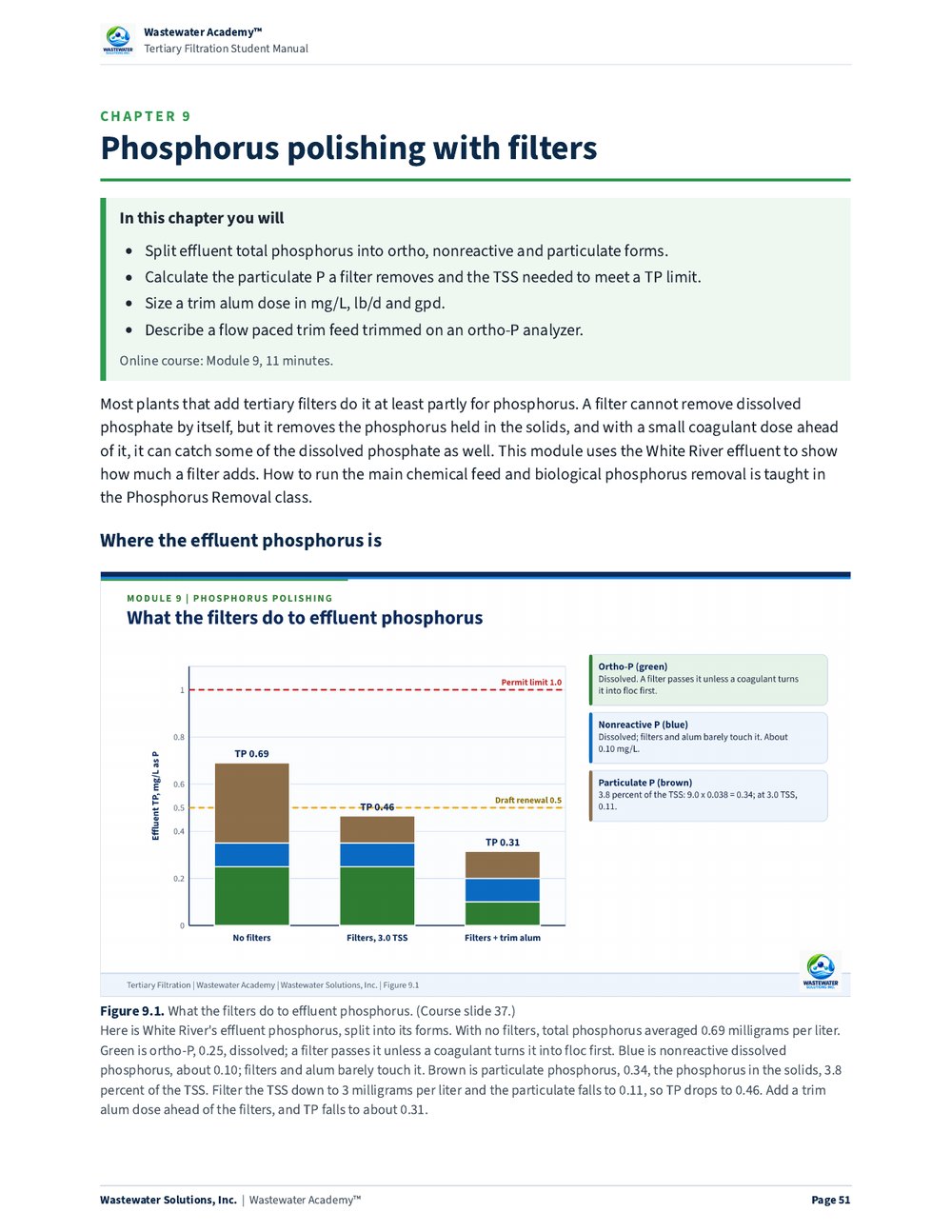
These are sample pages only. The full student manual comes with the class.
Register
2 hours, $70.
CEU approval status varies by state. Check with your state certification office before you count class hours toward a renewal.
Questions about this course? Contact help@ActivatedSludge.com.
Our courses have not been approved by any state agency unless a state approval number is shown. Whether a course counts toward your renewal is decided by your certifying authority. Please confirm with your state before enrolling. See where you can use these classes.
Registration is open. Register online and start right away.
After you pay, you are taken to a page where you start the online course and download the student manual. Work through the 10 modules in order; each ends with a 4-question check, and you need 3 of 4 to open the next module. The study timer counts time only while a module page is open and in the foreground, and you have been active in the last 5 minutes. It pauses when the tab is in the background or idle. Module checks open after about 30 percent of that module's required study time is logged. The final quiz opens after every check is passed and 1 hours 50 minutes of study are logged. It has 15 questions; you need 80 percent, with up to 3 attempts. After you pass and fill in a short course evaluation, you get a certificate of completion from Wastewater Academy™ in the name you enroll with. Online access, including the course, manual, quiz, and certificate, lasts 90 days from purchase. To see the style of questions first, try a free practice quiz.
Before you buy, read our refund policy, terms of use and privacy notice.
Certificate Only, $56: Same online course, manual and final quiz, with 90 days of access. The certificate reads “Certificate of Completion. Not submitted for continuing education credit.” and lists no contact hours, CEUs or license numbers. See terms.
Taking more than one class? This class is part of the All-Access Pass: every online class except Indiana exam prep, for 365 days, for $220. Training a crew? See group pricing.
See the All-Access Pass