
White River Resource Recovery Facility (WRRRF)
Our training plant. It is fictional: every number on this page was made up for teaching and does not describe any real utility.
White River Resource Recovery Facility (WRRRF) is a made-up plant in central Indiana on the White River. It has the equipment, data and problems of a real 8.0 MGD plant, so operators can practice on it without risk. Our classes, manuals and calculators all use it.
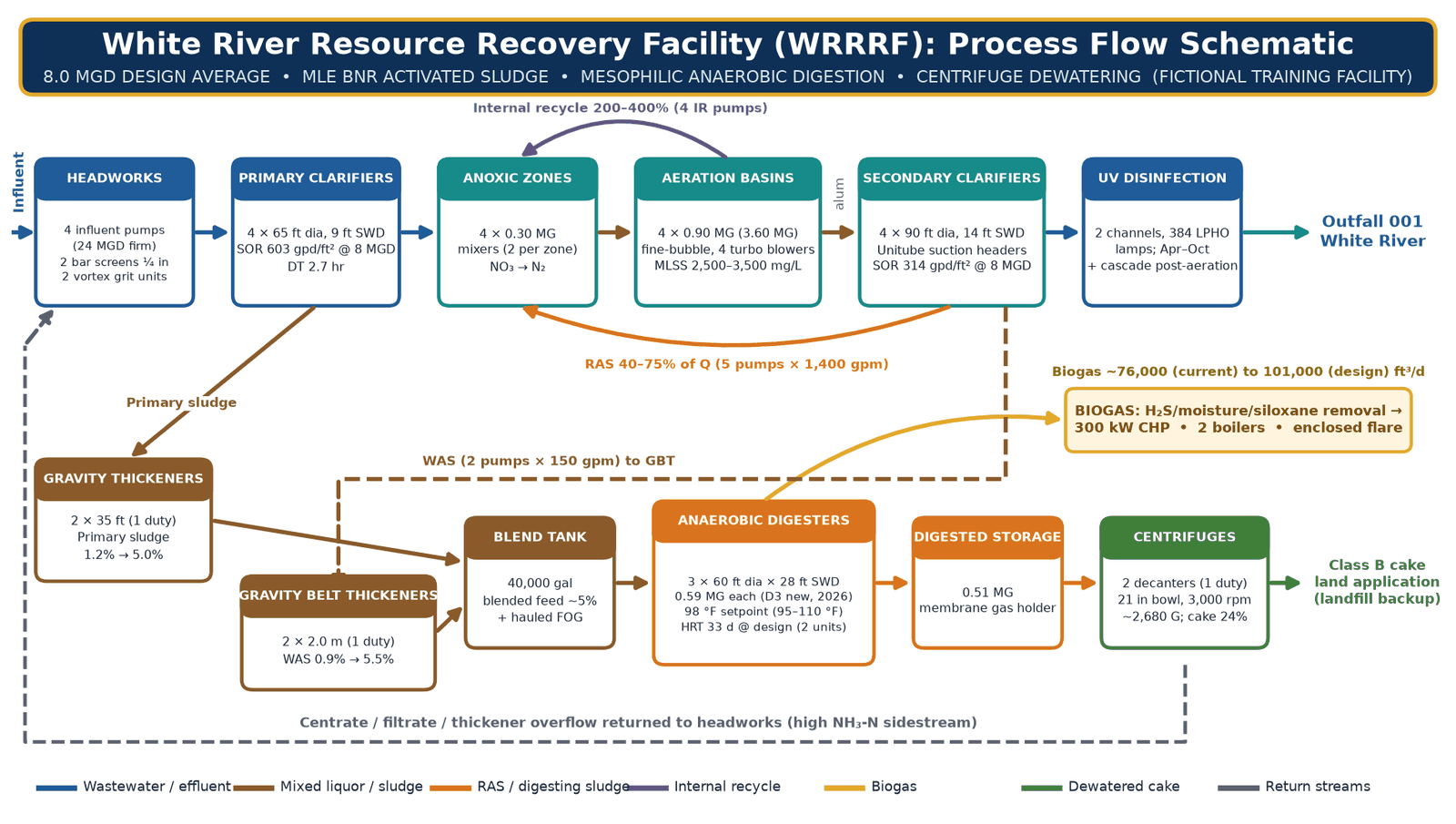
Process: conventional activated sludge with Modified Ludzack-Ettinger (MLE) biological nitrogen removal, chemical phosphorus removal (alum), UV disinfection, mesophilic anaerobic digestion with CHP, centrifuge dewatering, Class B land application. Built 1978; upgrades 1998, 2014, 2026. Staff (fictional): 12 operators (24/7 coverage), 5 maintenance, 2 lab, 1 I&C technician, superintendent, assistant superintendent.
Process flow
How we use the plant in class
Every exercise follows the same five steps, the way a good operator works a problem on shift.
- ObserveWhat do you see? Blanket depth, foam, color, the settleometer, the trend screen.
- VerifyIs the data right? Check the meter, the sample, the lab bench sheet and the field reading.
- CalculateRun the numbers: SVI, SRT, loads, state point, polymer dose.
- DecidePick one change, sized to the math, within your procedures and your authority.
- RecheckDid it work? Set a time to look again, and write down what you did and why.
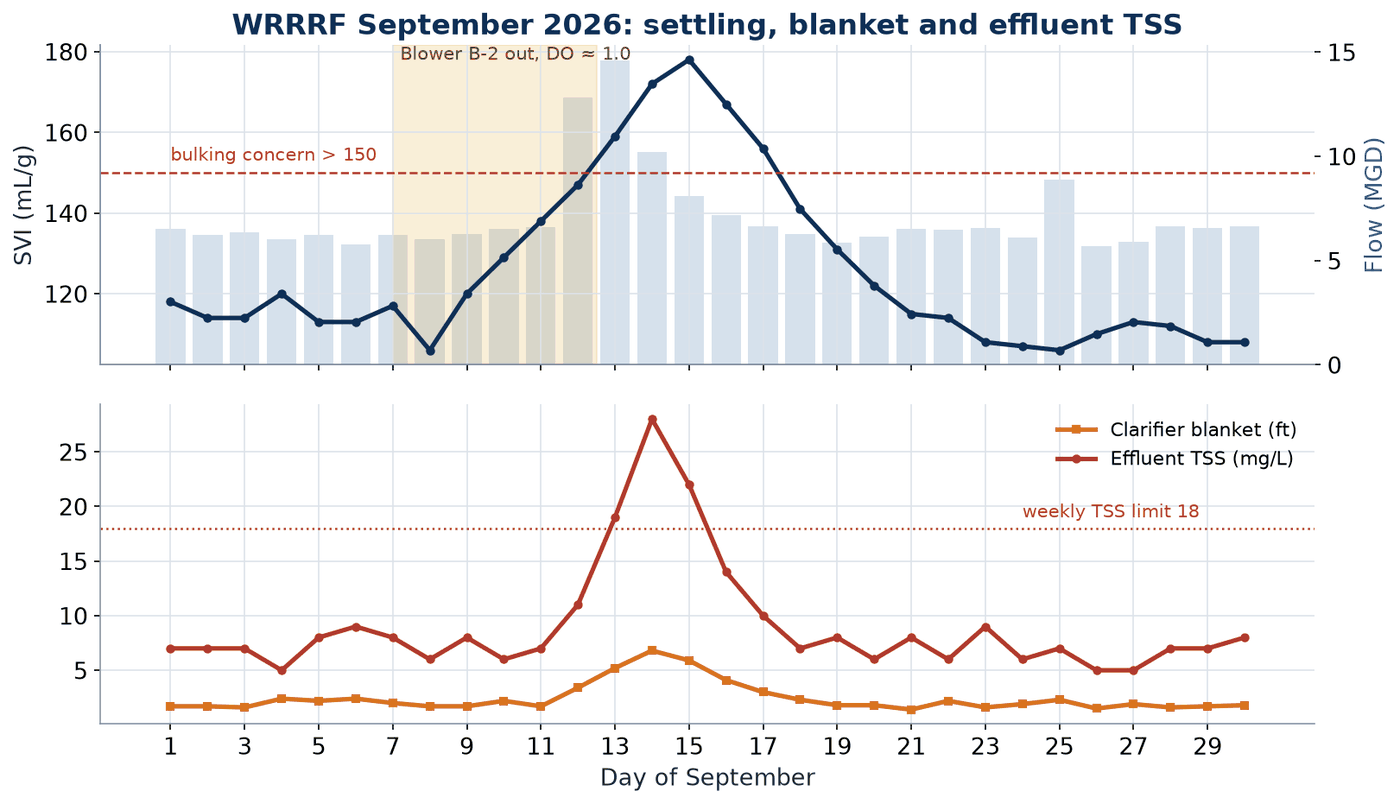
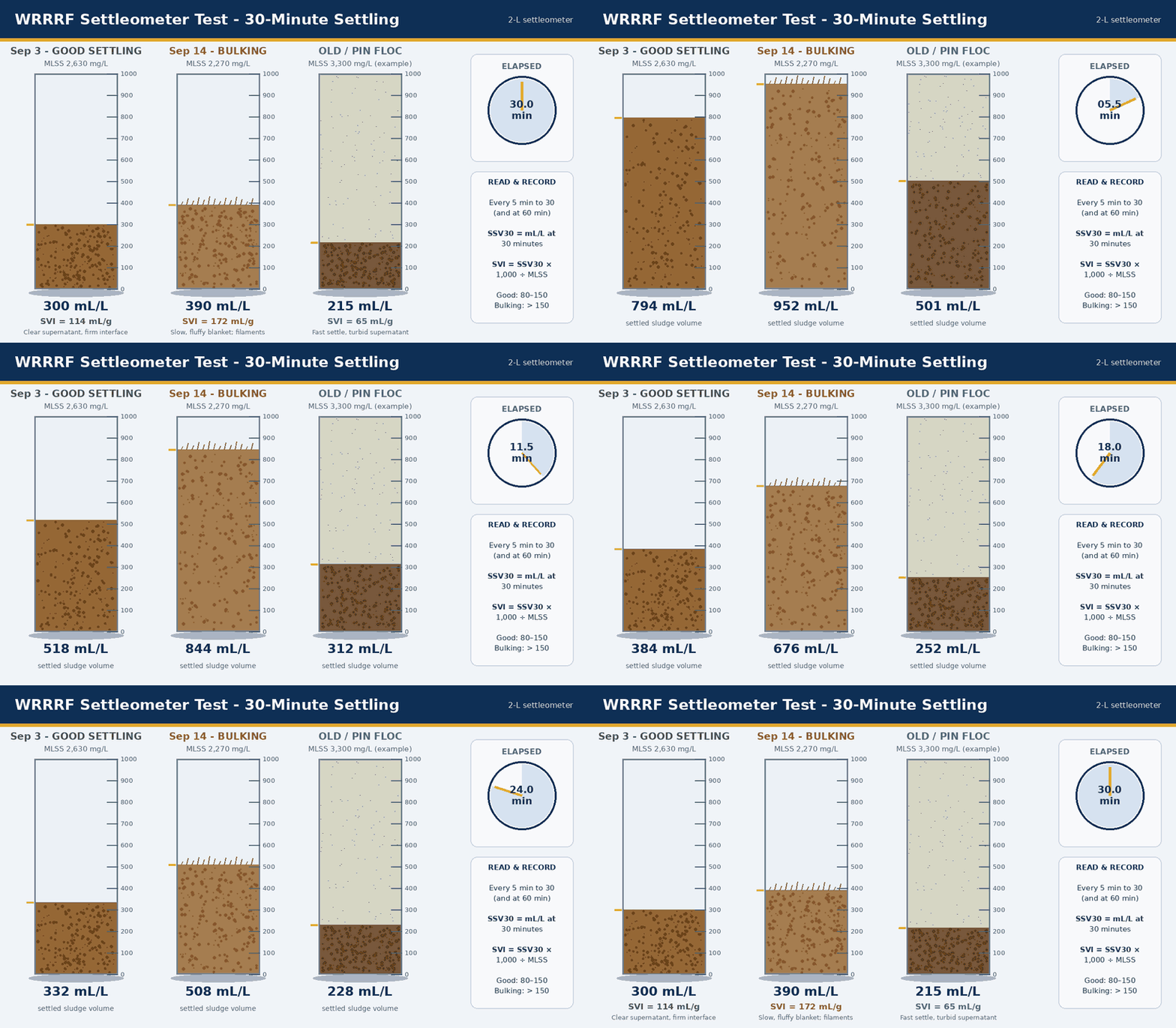
Try it on the September storm. On Monday, September 14 the blankets are at 6 to 7 ft and effluent TSS is 28 mg/L. Load the Sunday night peak hour (about 21 MGD) in the clarifier calculator: the model predicts thickening failure at that day's RAS, which is how the blanket got so high. Then load September 14: at 10.2 MGD and 5.2 MGD of RAS both checks pass, so the blanket should come down. Recheck: it was back to 2 to 3 ft by September 17 and 18.
Open the clarifier calculatorThe process units
Headworks
- 4 influent pumps, 24 MGD firm capacity
- 2 multi-rake bar screens, 1/4 in openings
- 2 vortex grit chambers, 16 ft
- Flow: 24 in Parshall flume (FIT-100)
Primary clarifiers
- 4 x 65 ft, 9 ft side water depth
- Overflow rate 603 gpd/sq ft at design
- Removes about 32% of BOD and 60% of TSS
- Primary sludge 1.2% solids
Activated sludge
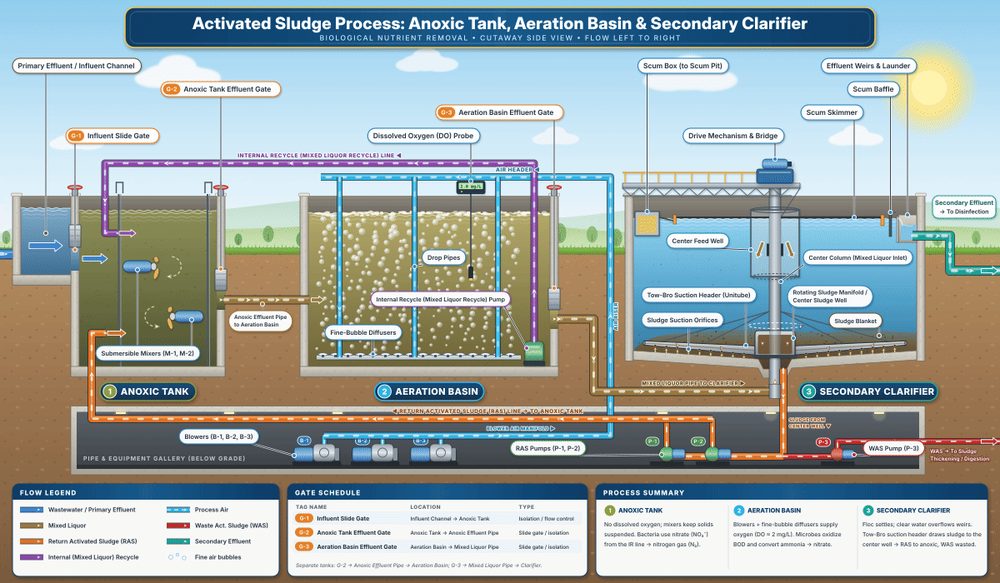
- 4 trains: anoxic zone, then a plug-flow aeration basin
- Aeration volume 3.6 MG; MLSS 2,500 to 3,500 mg/L (design 3,000)
- SRT 10 to 14 days aerobic; SVI 80 to 150 mL/g, target under 130
- 4 turbo blowers (3 duty), ammonia-based aeration control
- Alum for phosphorus removal
Secondary clarifiers
- 4 x 90 ft, 14 ft side water depth, 25,447 sq ft in all
- Overflow rate 314 gpd/sq ft at design, 943 at peak hour
- Suction header (Unitube) sludge collectors
- RAS: 5 pumps of 2.0 MGD (4 duty); design RAS 4.0 MGD
- Blanket target 1-3 ft (alarm at 4 ft)
UV disinfection
- 2 open channels, 384 lamps
- Season: April 1 to October 31
- Dose paced on flow and UV transmittance
- Cascade step aerator for effluent DO
Thickening
- Primary sludge: 2 gravity thickeners, 1.2% to 5.0%
- WAS: 2 gravity belt thickeners, 2.0 m belts, 0.9% to 5.5%
- GBT capture 95%, polymer 6 lb active per dry ton
- 40,000 gal blend tank
Anaerobic digestion
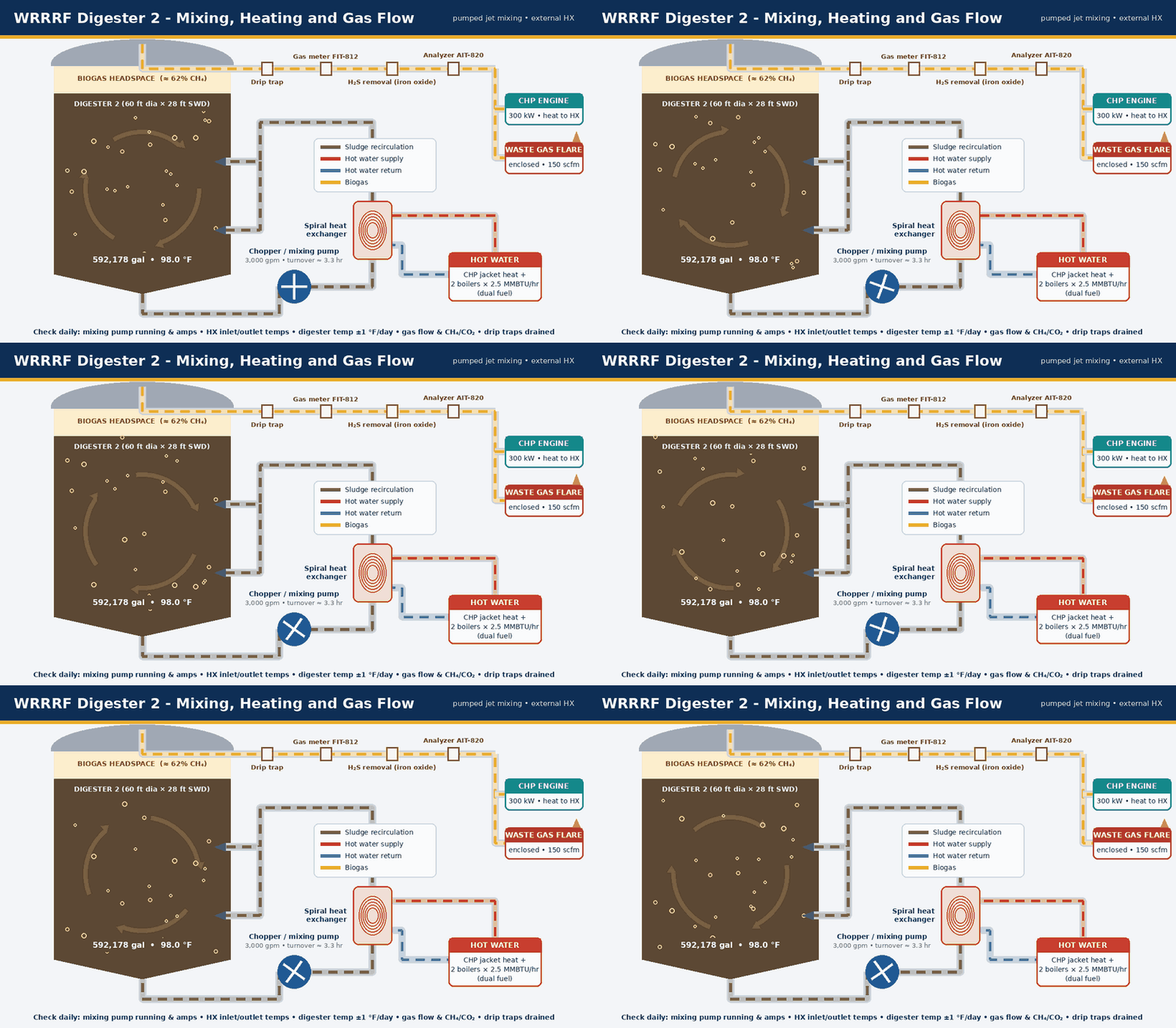
- 3 x 60 ft digesters at 98 F (Digester 3 being commissioned)
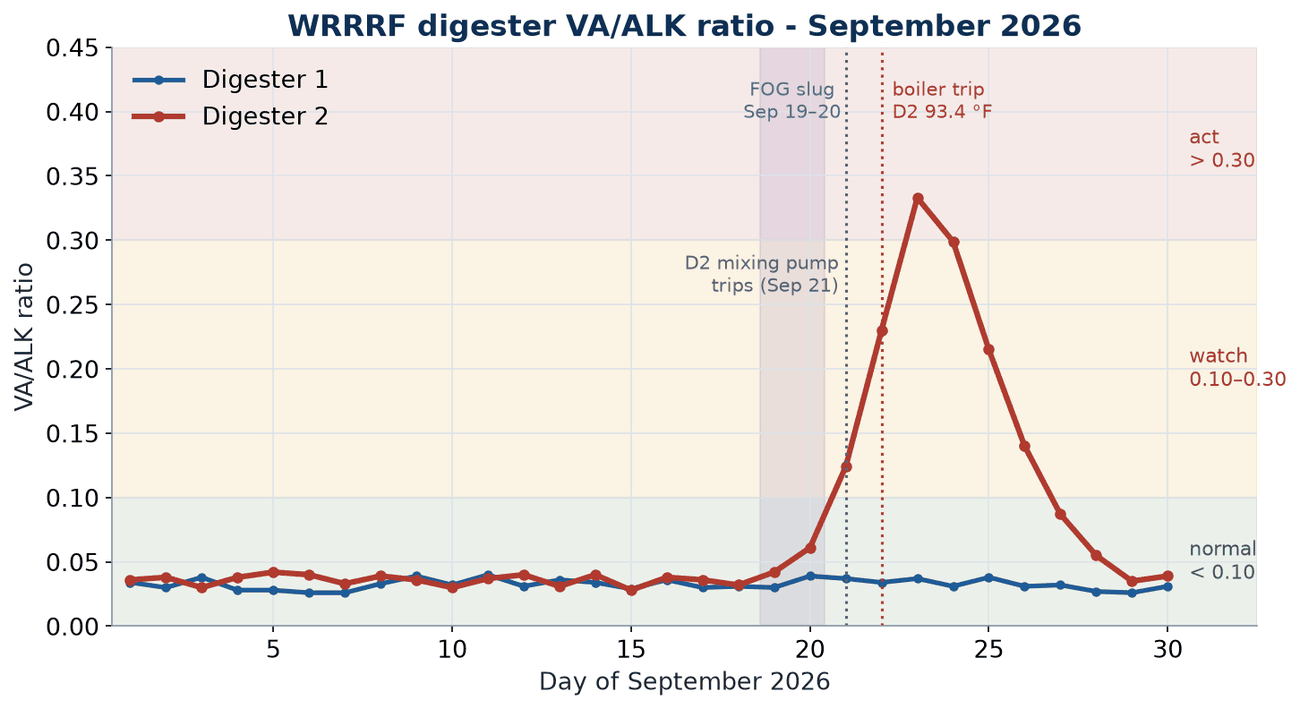
- VA/ALK: under 0.10 normal, 0.10 to 0.30 watch, over 0.30 act
- Biogas to a 300 kW CHP engine, 2 boilers and a flare
- Hauled FOG and food waste up to 5,000 gpd
Dewatering and biosolids
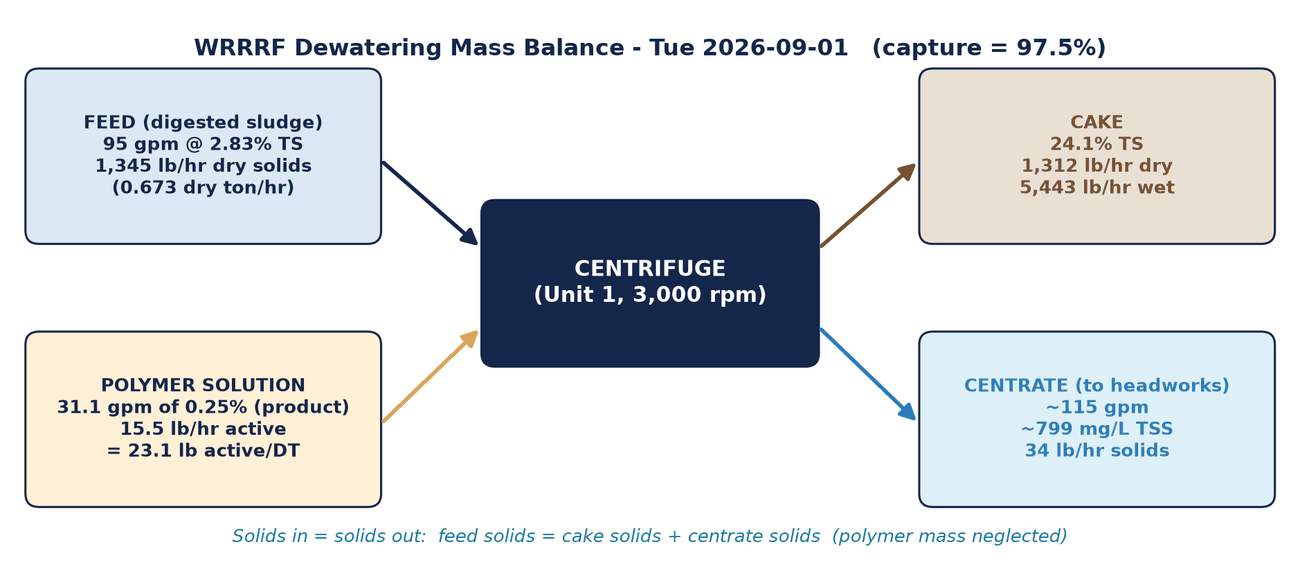
- 2 decanter centrifuges (1 duty), 21 in bowl, 3,000 rpm
- Cake target 24% (range 22 to 26%); capture 95% or better
- Polymer about 25 lb active per dry ton
- Class B cake, land applied; 120-day covered storage
Permit limits (fictional)
Permit IN0099991, Outfall 001 to the White River. Summer is May 1 to October 31; winter is November 1 to April 30.
| Parameter | Summer | Winter |
|---|---|---|
| CBOD5 (mg/L) | 10 monthly / 15 weekly | 25 monthly / 40 weekly |
| TSS (mg/L) | 12 monthly / 18 weekly | 30 monthly / 45 weekly |
| Ammonia nitrogen (mg/L) | 1.5 monthly / 3.0 daily max | 2.5 monthly / 5.0 daily max |
| Total phosphorus (mg/L) | 1.0 monthly | 1.0 monthly |
| E. coli (cfu/100 mL) | 125 geometric mean / 235 daily max (April to October) | Not required |
| Dissolved oxygen (mg/L) | at least 6.0 | at least 5.0 |
| pH | 6.0 to 9.0 | 6.0 to 9.0 |
September 2026: a month of operating data
Our classes work through one month of daily data. September averaged 7.09 MGD, MLSS 2,616 mg/L, SVI 126 mL/g and effluent TSS 9.0 mg/L, but it was not a quiet month.
How White River measures SVI. The plant's SVI comes from the standard unstirred 30-minute settling test in a 2 L settleometer: SVI (mL/g) = settled volume at 30 minutes (mL/L) × 1,000 / MLSS (mg/L). Stirred and unstirred tests give different numbers, so compare only results from the same method. The calculators give training estimates; check every result against your own plant data before you change anything.
Work the numbers yourself. The clarifier, SVI and pounds per day calculators load White River days with one button.
Open the operator toolsClasses that use the White River plant
The White River Resource Recovery Facility (WRRRF), its permit, its staff and its data are fictional and were made up for teaching. Any likeness to a real plant or utility is by chance.
Plan training for your plant
Tell us about your plant and your staff. We will talk through the classes and the training that fit.
Call 503-701-2766 or email help@ActivatedSludge.com.