Activated Sludge Basics
Level 1 of the activated sludge series. How the process works, the organisms, daily rounds, the settleometer, the microscope and the basic math, in plain language, taught at a fictional training plant.
CEUs not yet approved, for learning only
Who it is for
New operators, operators preparing for entry-level certification (for example Indiana Class I and II, or the equivalent in your state), lab technicians, and small-plant operators who want a solid start in activated sludge.
Format
Online, self-paced: 8 short modules with the instructor's lessons, calculators, "try it" questions and a check after each module, plus a downloadable student manual.
Length and price
3 hours (180 minutes of instruction), $100.
The activated sludge series
Start with Basics, then move up. Each level builds on the one before.
Level 1: Activated Sludge Basics
This course. How it works, the bugs, rounds, the settleometer, the microscope and basic math. No process control experience needed.
Level 2: Activated Sludge Process Control
SRT, F/M and SVI, RAS and WAS rates, clarifier loadings and troubleshooting. See Process Control.
Level 3: Advanced Activated Sludge
Nutrient removal, filaments, aeration, the state point, toxicity and case studies. See Advanced.
What you will learn
Taught by Brad Musick. 8 modules. Examples come from the White River Resource Recovery Facility (WRRRF), a fictional training plant.
- Start here (10 min)How the course works, the 8 objectives, the White River training plant and a self-check quiz.
- How activated sludge works (25 min)The process in plain words: aeration basin, secondary clarifier, sludge blanket, RAS and WAS, and the terms you will hear (SRT, F/M, SVI) explained without the math.
- The organisms and what they need (25 min)Bacteria and floc, protozoa and rotifers as indicators, filaments and bulking, and what the bugs need: DO, food, time, temperature, pH and alkalinity, and nutrients.
- Daily rounds and safety (20 min)A rounds route, what normal looks, smells and sounds like, writing a useful log entry, and safety at basins and clarifiers.
- Sampling, the settleometer and lab numbers (25 min)Representative samples, running and reading a 30-minute settleometer, what MLSS, MLVSS, DO, pH and blanket depth tell you, and watching trends.
- Microscope basics (15 min)Microscope parts, making a wet mount, what to record, and recognizing common indicator organisms.
- Basic activated sludge math (30 min)Step-by-step math: conversions, tank volume, detention time, the 8.34 pounds formula, percent removal, MLSS inventory and lab math, with "try it, then reveal" examples.
- When to call your supervisor, and practice (20 min)Foam colors and other warning signs, what to report and how, and 18 practice problems with an answer key.
Free practice tool. Try the free operator math practice quiz to see where you stand.
Open the math practice quizLearning objectives
At the end of this course, participants will be able to:
- Describe, in plain words, how an activated sludge plant works: the aeration basin, the secondary clarifier, return activated sludge (RAS) and waste activated sludge (WAS).
- Identify the main organisms in activated sludge (bacteria, protozoa, rotifers and filaments) and explain what they need: dissolved oxygen, food, time, the right temperature, pH and alkalinity, and nutrients.
- Make daily rounds of an activated sludge process, recognize what normal looks, smells and sounds like, record what you see, and work safely around aeration basins and clarifiers.
- Collect representative process samples and run, read and record a 30-minute settleometer test.
- Prepare a wet mount, use a microscope at 100x and 400x, and recognize common indicator organisms.
- Explain what basic lab and field numbers (MLSS, MLVSS, DO, pH, temperature, blanket depth, effluent TSS and CBOD5) tell you, and compare them with normal ranges for your plant.
- Solve basic activated sludge math step by step: unit conversions, tank volume, the pounds formula (8.34), detention time, percent removal and MLSS inventory.
- Recognize common warning signs (foam color, bulking, rising sludge, cloudy effluent, low DO, equipment trouble) and report them clearly to your supervisor.
Instructor, completion rules and credit
Instructor
Brad Musick, 45 years in wastewater treatment, Class IV operator in Indiana and Hawaii, and former superintendent of two Indiana plants. Each module has an "Ask the instructor" link: Brad reads every question and replies by email.
How you complete it
Work through the 8 modules in order. Each module ends with a 4-question check; you need 3 of 4 to open the next module. The final quiz opens after every check is passed and about 170 minutes of study are logged. It has 20 questions drawn from all 8 objectives; you need 80 percent, with up to 3 attempts, then instructor review. After you pass and fill in a short course evaluation, you get a certificate of completion in the name you enroll with.
Continuing education credit
CEUs not yet approved, for learning only. Check with your certifying body about what it accepts before you enroll.
Access
90 days of online access from purchase: the course, the student manual (up to 3 downloads), the final quiz and your certificate. A certificate you earn can be reprinted later.
What you need
A computer or tablet with a current web browser (Chrome, Edge, Firefox or Safari) with JavaScript on, an internet connection, a PDF reader for the manual, and a basic calculator. The study timer counts time only while a module page is open and in front, and you have been active in the last 5 minutes.
Prefer it live?
Brad can teach this course live over Microsoft Teams or on-site at your plant. See on-site training or contact us.
What operators take away
- A clear picture of how the aeration basin, clarifier, RAS and WAS work together.
- A rounds routine: what normal looks, smells and sounds like, and what to write down.
- How to run and read a settleometer and make a microscope wet mount.
- Step-by-step basic math: pounds, detention time, percent removal and MLSS inventory.
- A foam color and warning sign guide, and what to tell your supervisor.
- A final quiz that tests all 8 objectives, and a certificate of completion from Wastewater Academy™ when you pass it.
- A student manual to download (comes with the class).
Look inside
A few sample pages from the student manual. Tap a page to open it full size.
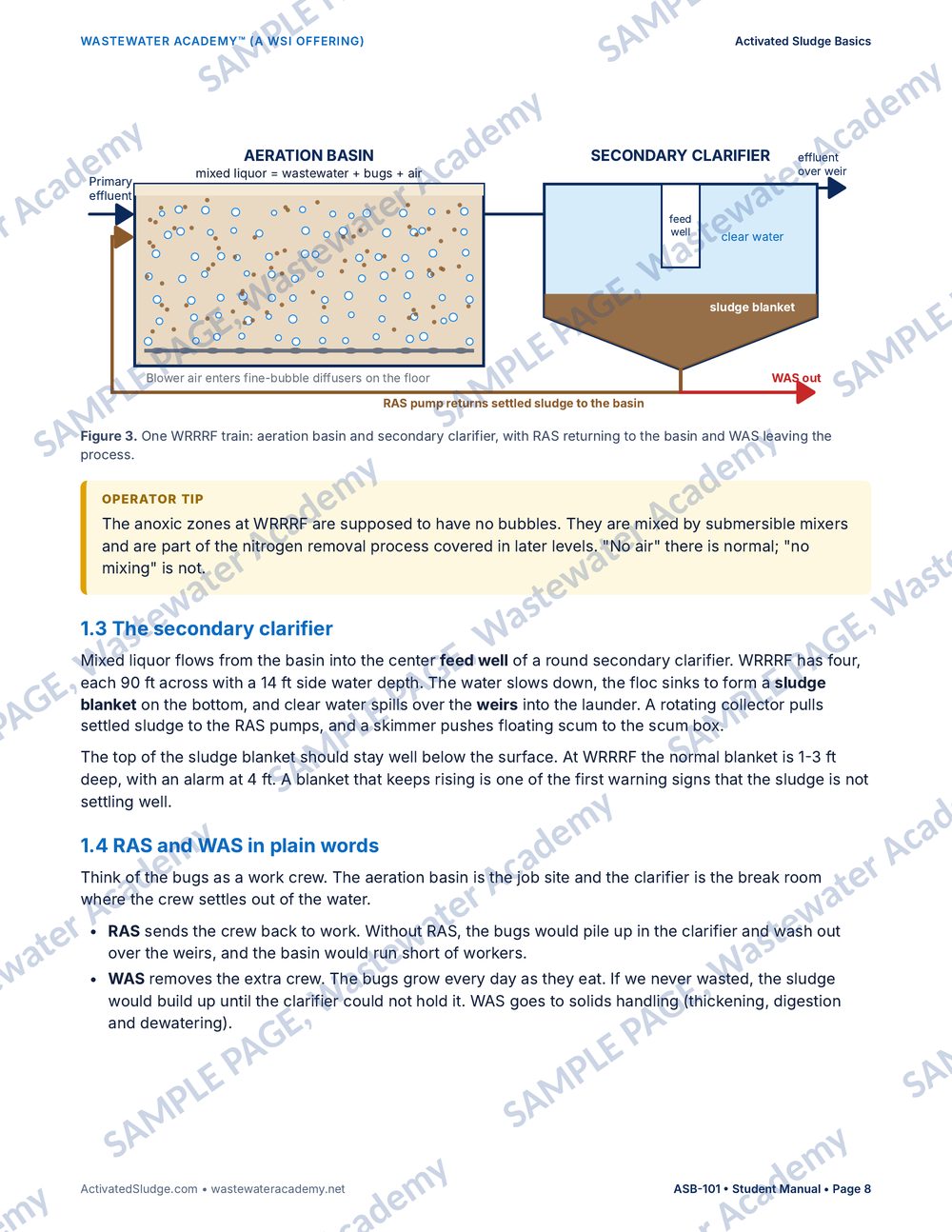
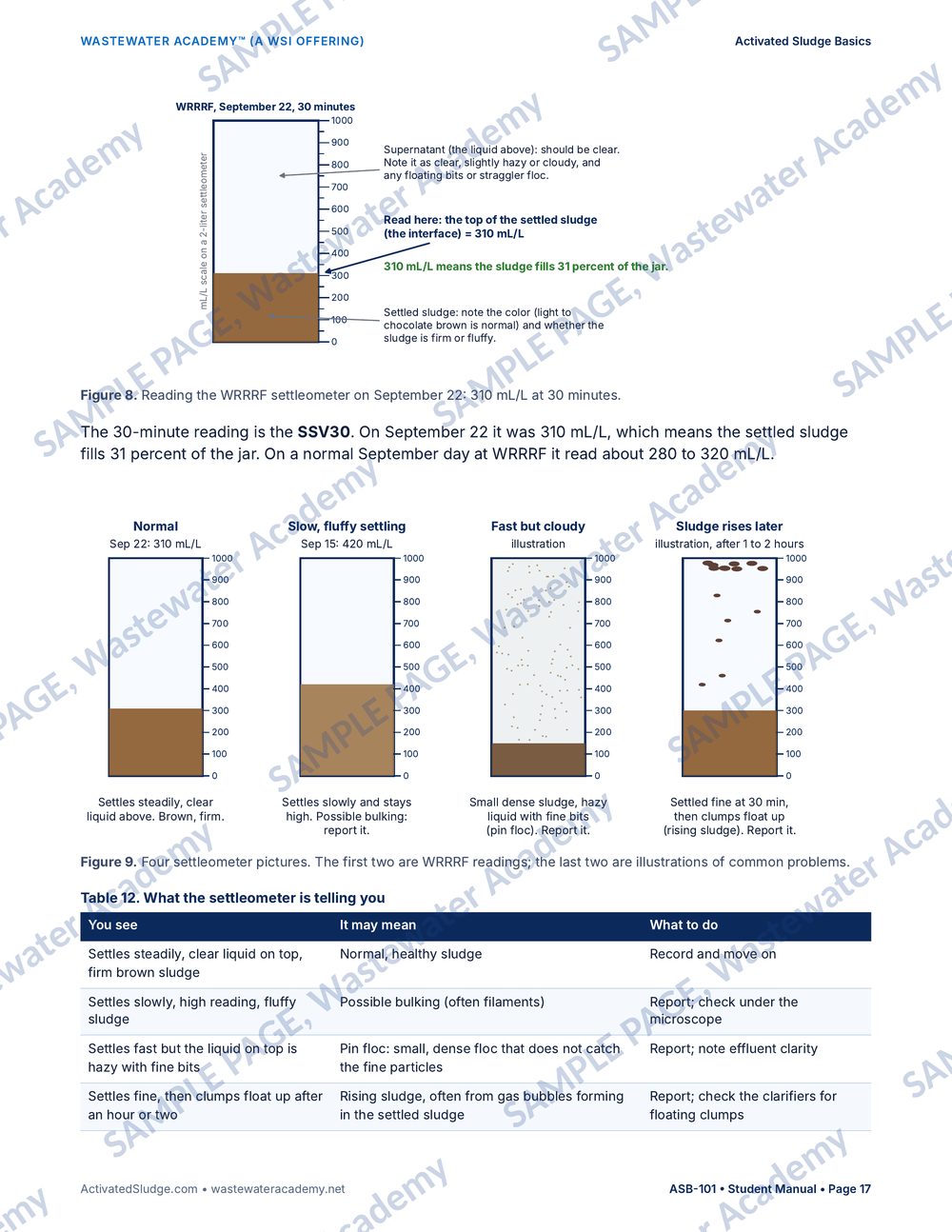
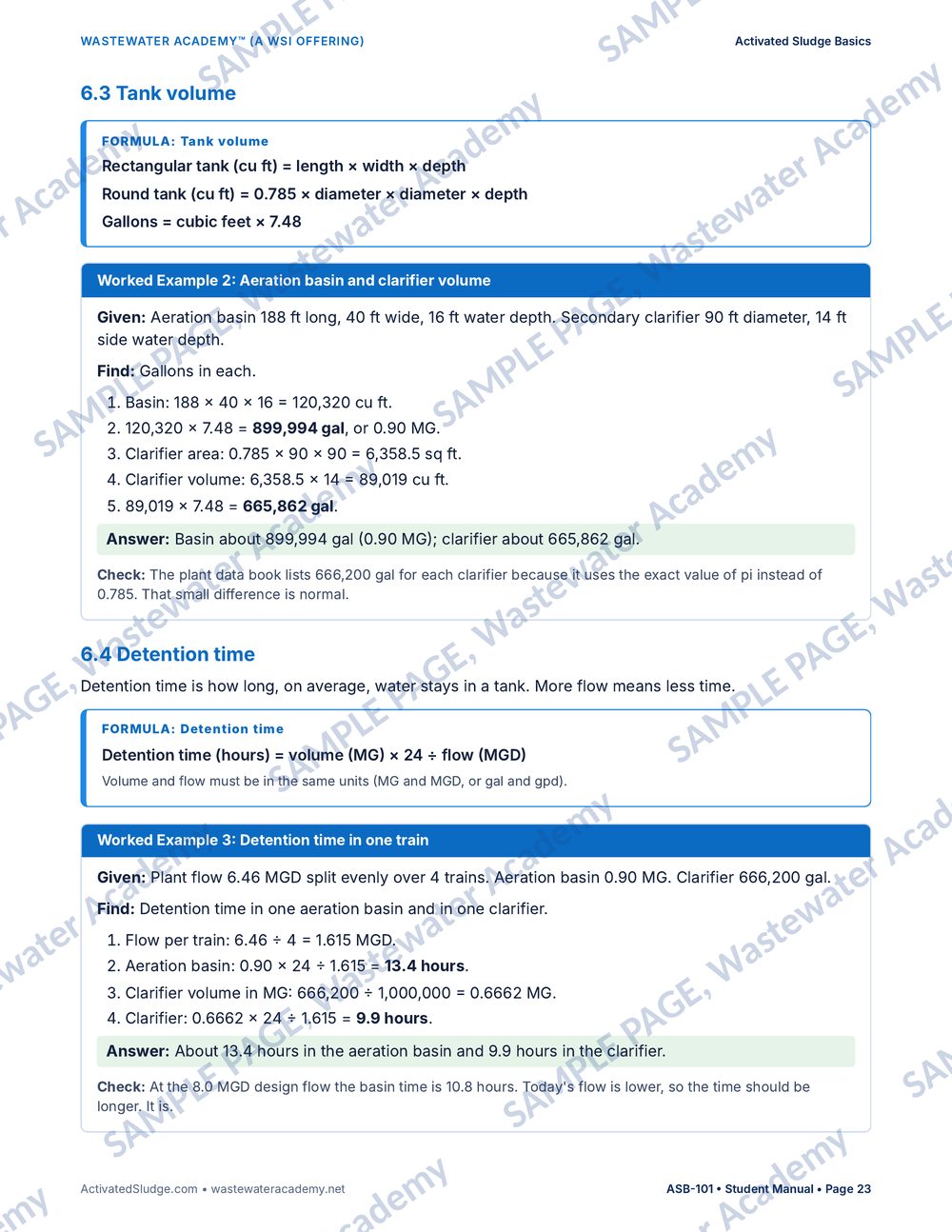
These are sample pages only. The full student manual comes with the class.
Register
3 hours, $100.
CEUs for this class are not yet approved in any state. If you need CEU credit, please do not buy this class until CEUs are approved; we will announce approval here. Purchase is for learning only.
Need CEU credit? Ask us to tell you when CEUs are approved (tell us your state and this class), or email help@ActivatedSludge.com.
Registration is open for learning only. At checkout you confirm that you understand this class has no CEU credit yet.
After you pay, you are taken to a page where you start the online course and download the student manual. The final quiz opens after the 8 modules and their checks, and you get a certificate of completion from Wastewater Academy™ when you pass it and complete the course evaluation. Online access, including the course, manual, quiz, and certificate, lasts 90 days from purchase. To see the style of questions first, try a free practice quiz.
Before you buy, read our refund policy, terms of use and privacy notice.