Lagoon Operation
Run a lagoon system with confidence: read what the algae, the DO and the pH are telling you, do the loading and detention math, measure the sludge, find short circuiting, get through winter, and keep the effluent in compliance.
Who it is for
Operators of facultative, aerated and polishing lagoon systems, operators preparing for small system or lagoon certification exams, and managers and engineers who oversee small town and industrial lagoons.
Format
Online, self-paced: 11 timed modules with the manual reading, worked examples and a short check after each module, plus the student manual to download.
Length and price
3 hours, $105.
What you will learn
11 modules. Every example uses one fictional system: the Millbrook Wastewater Lagoons, a four cell lagoon plant with an aerated cell, two facultative cells, a polishing pond and sand filters.
- Lagoon systems and how they work (17 min)Facultative, aerated, anaerobic and polishing lagoons, the three zones in a facultative cell, series and parallel, and the Millbrook system.
- Algae, bacteria, DO and pH (16 min)How algae and bacteria trade oxygen and carbon dioxide, why DO and pH swing every day, and what lagoon colors mean.
- Loading and detention math (18 min)Area, volume, detention time, pounds, areal loading in lb BOD per acre per day, oxygen demand and blower energy.
- Aerated cells (15 min)Diffusers and aerators, DO targets, blower pressure as a diffuser check, condensate, mixing and power outages.
- Monitoring and sampling (16 min)A monitoring plan, diurnal readings, field meter calibration, grab and composite samples, level readings and the log.
- Ammonia and phosphorus (16 min)How ammonia leaves a lagoon by season, free ammonia and pH, nitrification limits, and phosphorus removal with alum.
- Effluent quality and polishing (15 min)Algae solids and effluent TSS, draw-off depth, alum and sand filters, disinfection and dechlorination, pH and DO at the outfall.
- Sludge (15 min)How sludge builds up, sludge surveys with a core sampler, volume and dry tons, and planning sludge removal.
- Flow patterns, odors and upkeep (15 min)Dye tests and short circuiting, baffles, odors and spring turnover, duckweed, burrowing animals, dikes and seepage.
- Winter operation (14 min)Fall preparation, level and storage, ice and sludge shrinking detention, DO under ice, aerators in winter and spring startup.
- Troubleshooting and lagoon safety (13 min)A troubleshooting method and table, one change at a time, and lagoon safety: water, boats, ice, gases, algae toxins and electricity.
What operators take away
- How facultative, aerated, anaerobic and polishing lagoons work, and the three zones inside a facultative cell.
- Why DO and pH swing from dawn to afternoon, what lagoon colors mean, and how to read a diurnal profile.
- Lagoon math: volume, detention time, areal loading, oxygen demand, storage, seepage, sludge volume and dry tons, dye test ratios and chemical feed.
- How to run aerated cells, plan sampling, calibrate field meters, and keep ammonia, phosphorus, algae solids and pH within limits.
- How to survey sludge, find short circuiting with a dye test, handle spring turnover and odors, look after dikes, operate through winter, and troubleshoot one change at a time.
- Lagoon safety: drowning, boats, ice, gases, blue-green algae toxins and electrical hazards.
- Timed online modules with a short check after each one, a final quiz that opens when every check is passed and the study time is logged, and a certificate of completion from Wastewater Academy™ when you pass it.
- A student manual to download (it comes with the class).
Look inside
A few sample pages from the student manual. Tap a page to open it full size.
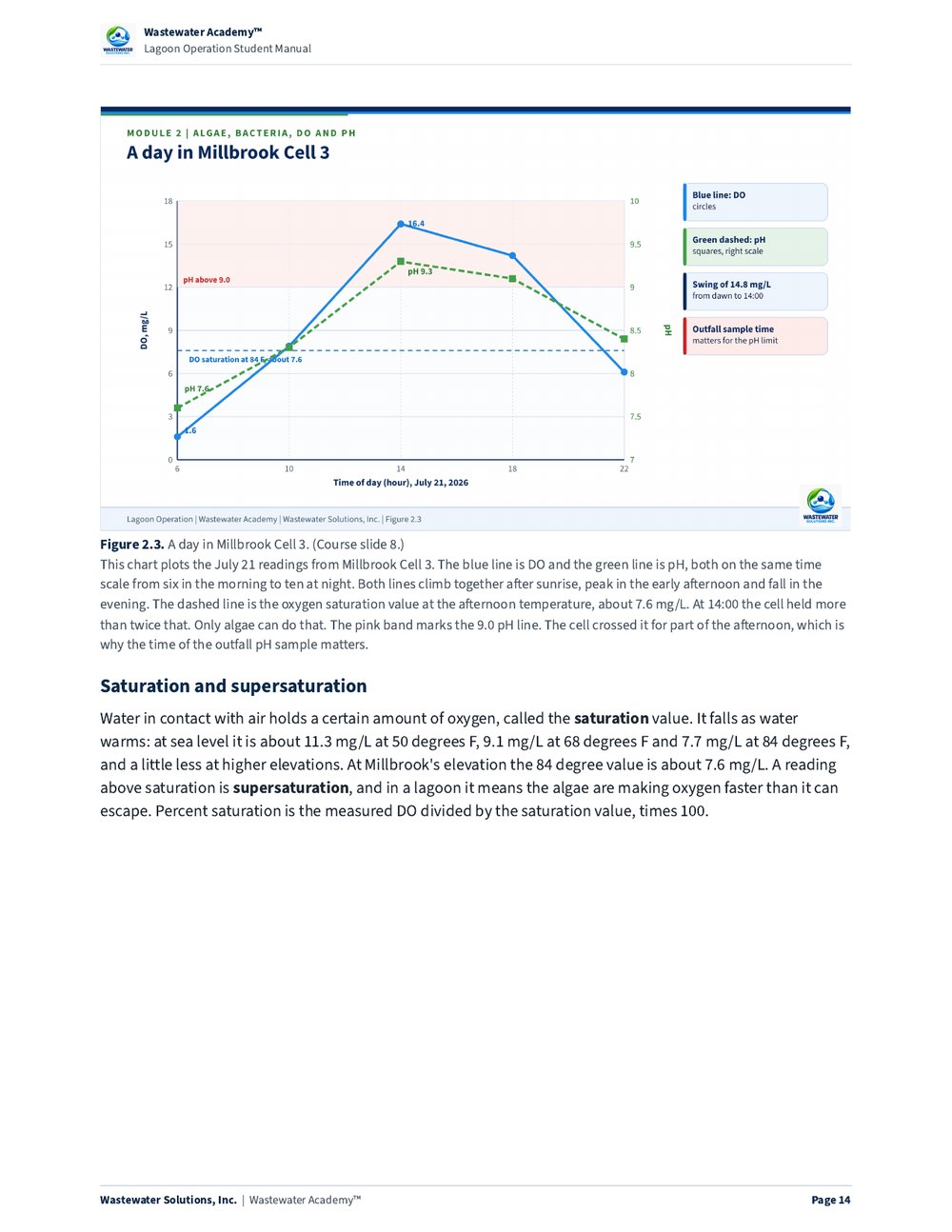
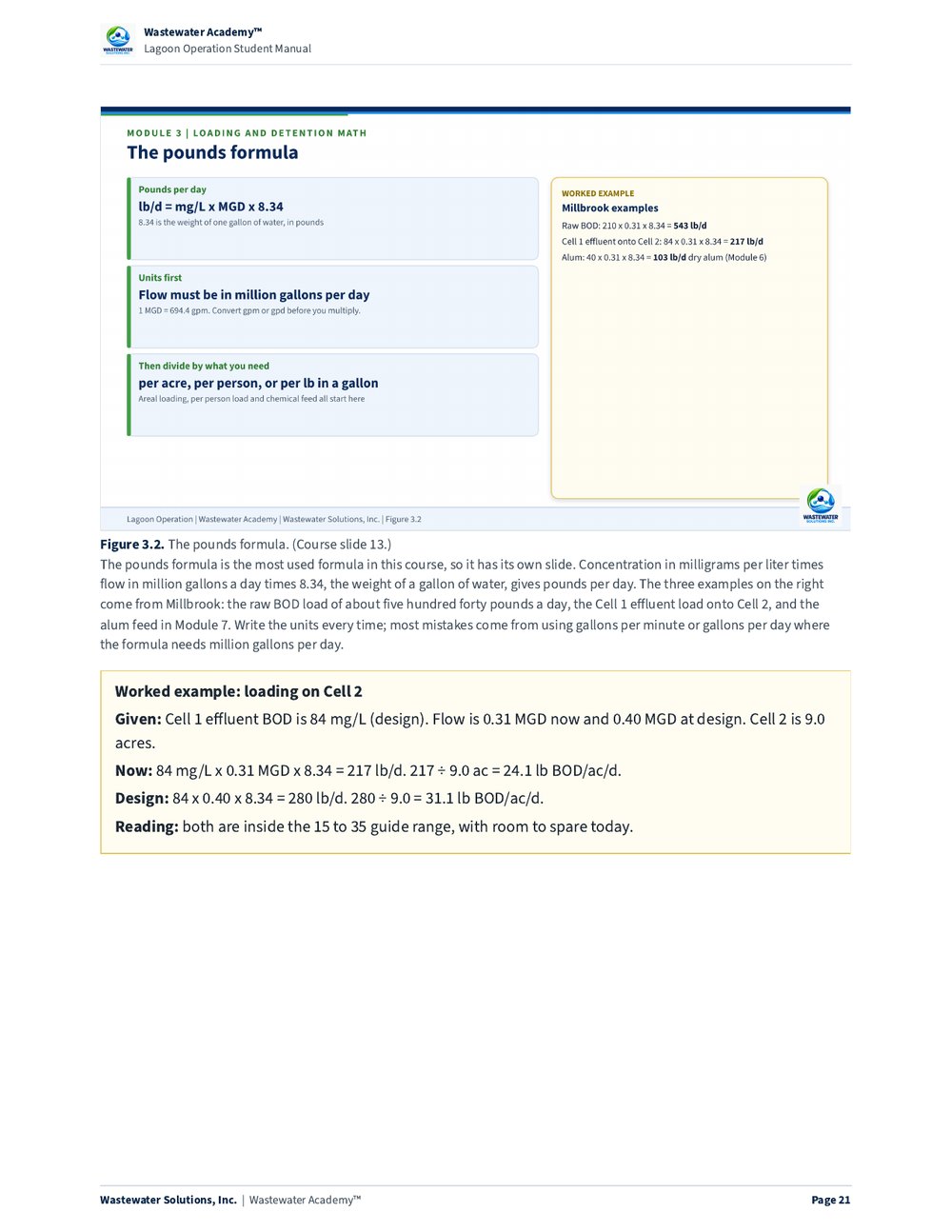
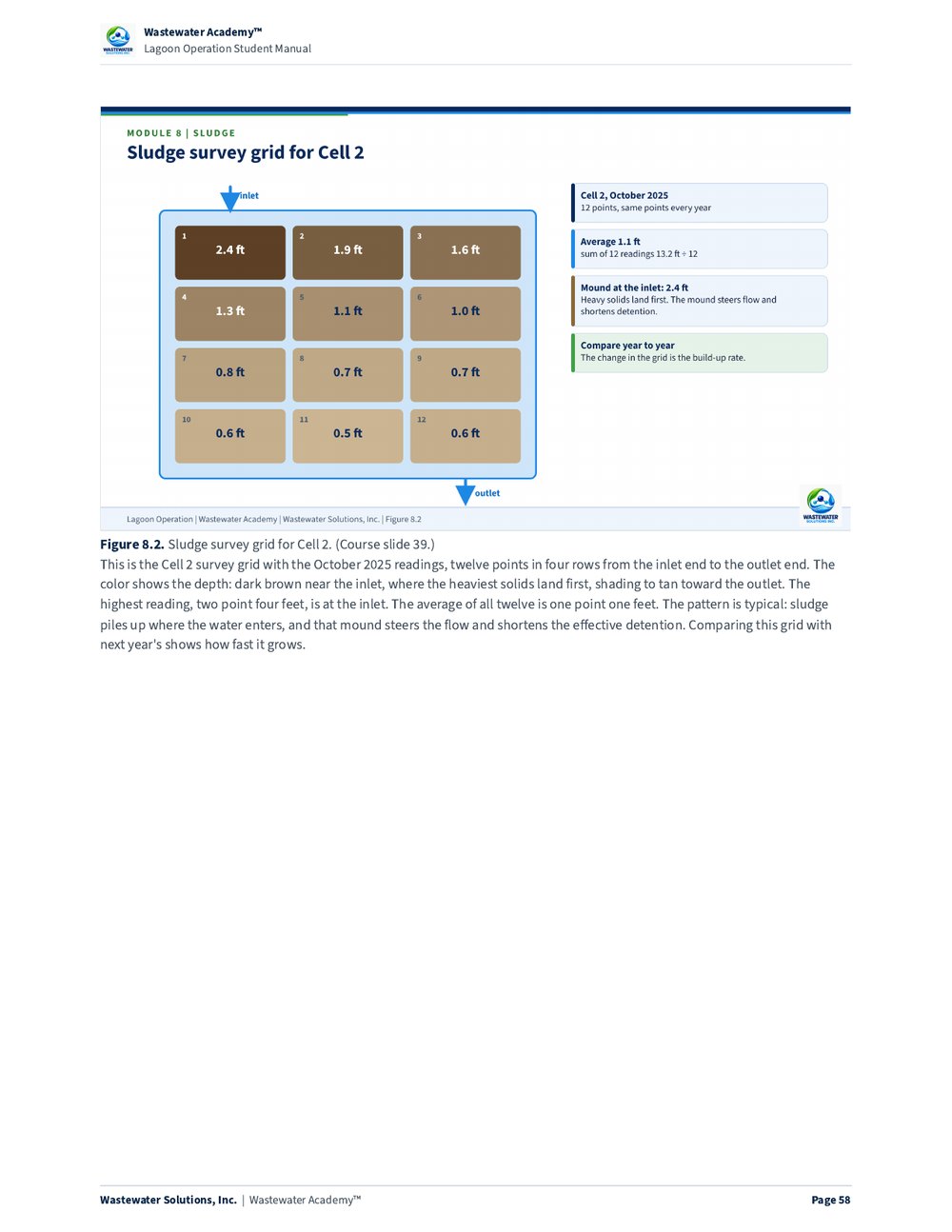
These are sample pages only. The full student manual comes with the class.
Register
3 hours, $105.
CEU approval status varies by state. Check with your state certification office before you count class hours toward a renewal.
Questions about this course? Contact help@ActivatedSludge.com.
Our courses have not been approved by any state agency unless a state approval number is shown. Whether a course counts toward your renewal is decided by your certifying authority. Please confirm with your state before enrolling. See where you can use these classes.
Registration is open. Register online and start right away.
After you pay, you are taken to a page where you start the online course and download the student manual. Work through the 11 modules in order; each ends with a 4-question check, and you need 3 of 4 to open the next module. The study timer counts time only while a module page is open and in the foreground, and you have been active in the last 5 minutes. It pauses when the tab is in the background or idle. Module checks open after about 30 percent of that module's required study time is logged. The final quiz opens after every check is passed and 2 hours 50 minutes of study are logged. It has 15 questions; you need 80 percent, with up to 3 attempts. After you pass and fill in a short course evaluation, you get a certificate of completion from Wastewater Academy™ in the name you enroll with. Online access, including the course, manual, quiz, and certificate, lasts 90 days from purchase. To see the style of questions first, try a free practice quiz.
Before you buy, read our refund policy, terms of use and privacy notice.
Certificate Only, $84: Same online course, manual and final quiz, with 90 days of access. The certificate reads “Certificate of Completion. Not submitted for continuing education credit.” and lists no contact hours, CEUs or license numbers. See terms.
Taking more than one class? This class is part of the All-Access Pass: every online class except Indiana exam prep, for 365 days, for $220. Training a crew? See group pricing.
See the All-Access Pass