Collection System Operation and Maintenance
Keep sewage moving from the lateral to the plant: gravity sewers, pipe and construction, force mains, lift stations, I/I, cleaning, H2S, safety and overflow response.
Who it is for
Collection system operators and crew leaders, lift station and maintenance staff, and plant operators who want to understand the system that feeds the plant.
Format
Online, self-paced: 12 timed modules with the manual reading, worked examples and a short check after each module, plus the student manual to download.
Length and price
5 hours, $175.
What you will learn
12 modules. Worked examples use a fictional collection system that feeds the fictional White River plant.
- What a collection system does and the rules it runs under (20 min)What the system must do from the lateral to the interceptor, separate and combined systems, and the permit and CMOM framework in plain language.
- Gravity sewers, manholes and laterals (26 min)Slope and the 2 ft/s cleaning velocity, slope from inverts, the Manning equation, partly full pipes, manholes and laterals.
- Pipe materials and joints (27 min)Gravity and force main pipe materials, older materials still in the ground, six joint types and how joints fail, and thrust at bends.
- Pipe installation: bedding, grade and acceptance testing (33 min)Trench zones, rigid and flexible pipe, laying to grade with a laser, sags, and air, mandrel, manhole vacuum and hydrostatic acceptance tests.
- Force mains, air valves and inverted siphons (18 min)Force main profiles and the hydraulic grade line, air valves, velocity and detention time, surge, and a double barrel inverted siphon.
- Lift stations (30 min)Submersible and wet well/dry well stations, set points and SCADA signals, pump and system curves, drawdown tests, cycling, run hours, backup power and bypass pumping.
- Infiltration and inflow (24 min)Inflow and infiltration sources, dry weather flow analysis, RDII volume and the R value, flow meters and smoke testing.
- Cleaning, FOG control and asset management (26 min)Jetting, rodding and root control, FOG and grease interceptors, hot spot cycles, CCTV condition grades and ranking pipes by risk.
- Hydrogen sulfide, odor and corrosion (20 min)Where sulfide forms and H2S is released, the pH effect, crown corrosion, and chemical and non chemical controls with a dosing example.
- Collection system safety (28 min)Permit-required confined space entry, gas testing and alarms, H2S effects, lane closures and tapers, trench protection, lockout and biological hazards.
- Troubleshooting lift stations and sewers (22 min)A seven step method, reading amps, drawdown and run time together, a high level alarm decision path, and troubleshooting tables for stations and sewers.
- Overflow response, reporting, rehabilitation and records (16 min)SSO response in order, estimating overflow volume, CIPP, pipe bursting and sliplining, records, and a capstone storm case.
What operators take away
- How gravity sewers, force mains, siphons and lift stations work, and what each looks like when it starts to fail.
- Pipe materials, joints, bedding and grade, and the air, mandrel, vacuum and hydrostatic tests used to accept new work.
- Collection system math you can check yourself: slope, Manning, velocity, drawdown, cycle time, run hours, RDII and the R value, chemical feed, taper length and overflow volume.
- Safe work habits for confined spaces, H2S, traffic, trenches and lockout.
- Troubleshooting tables for lift stations, force mains and gravity sewers, and an SSO response sequence.
- Timed online modules with a short check after each one, a final quiz that opens when every check is passed and the study time is logged, and a certificate of completion from Wastewater Academy™ when you pass it.
- A student manual to download (comes with the class).
Look inside
A few sample pages from the student manual. Tap a page to open it full size.
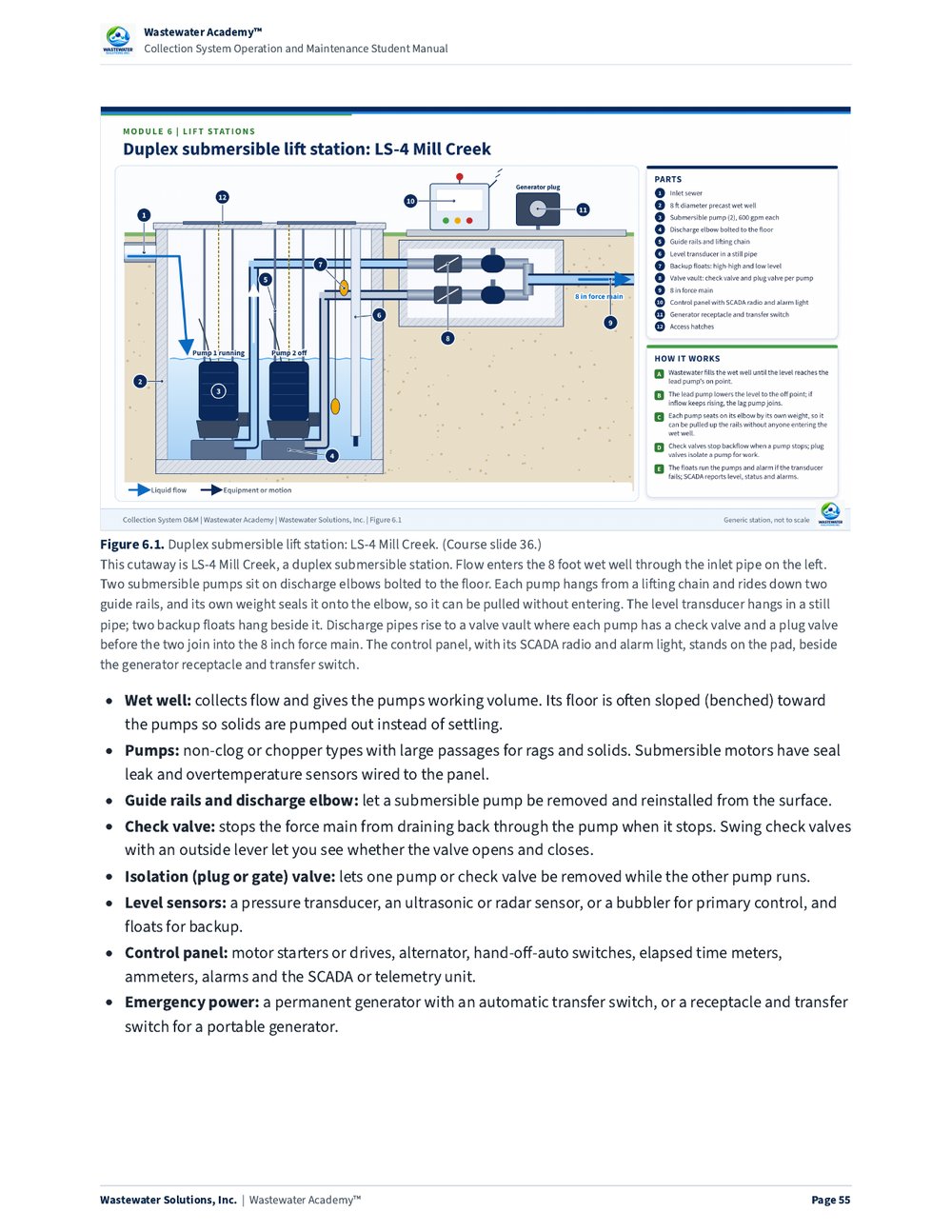
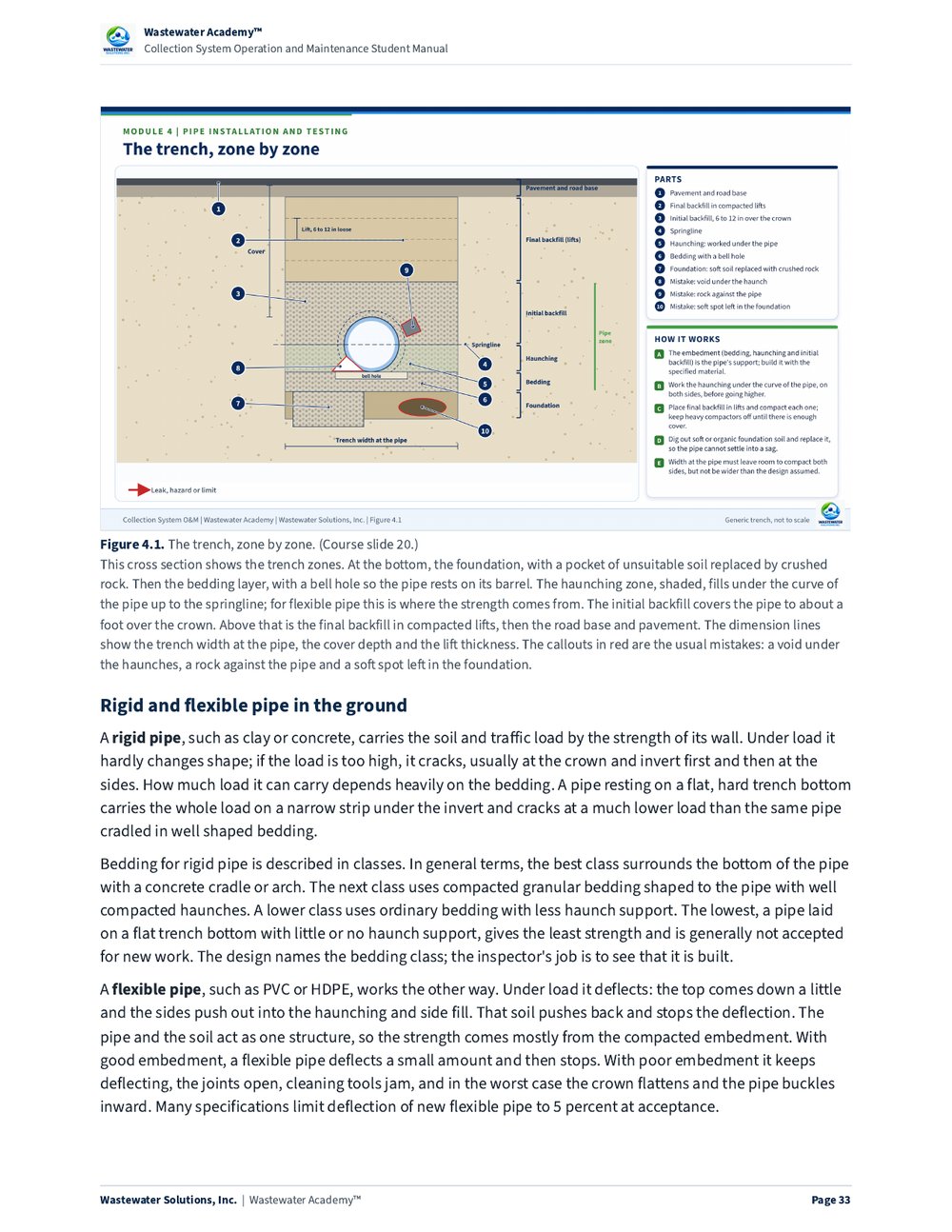
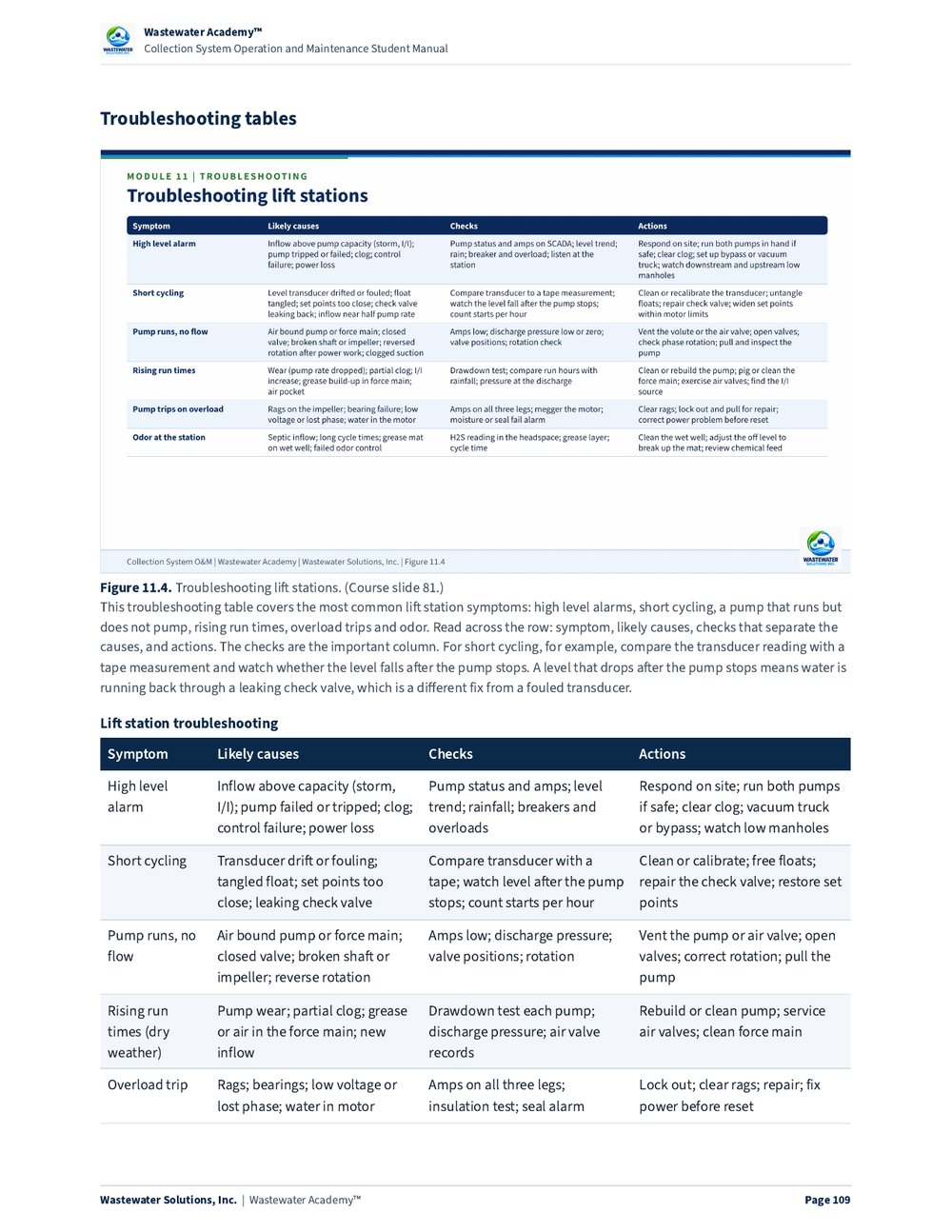
These are sample pages only. The full student manual comes with the class.
Register
5 hours, $175.
CEU approval status varies by state. Check with your state certification office before you count class hours toward a renewal.
Questions about this course? Contact help@ActivatedSludge.com.
Our courses have not been approved by any state agency unless a state approval number is shown. Whether a course counts toward your renewal is decided by your certifying authority. Please confirm with your state before enrolling. See where you can use these classes.
Registration is open. Register online and start right away.
After you pay, you are taken to a page where you start the online course and download the student manual. Work through the 12 modules in order; each ends with a 4-question check, and you need 3 of 4 to open the next module. The study timer counts time only while a module page is open and in the foreground, and you have been active in the last 5 minutes. It pauses when the tab is in the background or idle. Module checks open after about 30 percent of that module's required study time is logged. The final quiz opens after every check is passed and 4 hours 50 minutes of study are logged. It has 20 questions; you need 80 percent, with up to 3 attempts. After you pass and fill in a short course evaluation, you get a certificate of completion from Wastewater Academy™ in the name you enroll with. Online access, including the course, manual, quiz, and certificate, lasts 90 days from purchase. To see the style of questions first, try a free practice quiz.
Before you buy, read our refund policy, terms of use and privacy notice.
Certificate Only, $140: Same online course, manual and final quiz, with 90 days of access. The certificate reads “Certificate of Completion. Not submitted for continuing education credit.” and lists no contact hours, CEUs or license numbers. See terms.
Taking more than one class? This class is part of the All-Access Pass: every online class except Indiana exam prep, for 365 days, for $220. Training a crew? See group pricing.
See the All-Access Pass