Drinking Water Filters
Rapid gravity, pressure, slow sand, cartridge and membrane filters: media, loading rate, headloss, backwashing, filter to waste, turbidity monitoring and troubleshooting.
CEUs not yet approved, for learning only
Who it is for
Water treatment operators at surface water and groundwater plants, including operators who hold both water and wastewater licenses.
Format
Online, self-paced. Take it when it suits your shift.
Length and price
2 hours, $60.
What you will learn
10 modules. Worked examples use fictional drinking water systems.
- What a Filter DoesThe job of filtration in the multiple barrier approach, how granular media catch particles (straining, settling, contact and adhesion), depth filtration and why coagulation must come first.
- Types of FiltersRapid gravity filters in conventional and direct filtration, pressure filters, slow sand filters, diatomaceous earth, cartridge and bag filters, and low pressure membranes, with typical rates and uses.
- Filter Parts and MediaThe filter box, media layers, effective size and uniformity coefficient, support gravel and underdrains, wash troughs, surface wash, valves and rate control, using the White River filters.
- Filter Loading Rate and Unit Filter Run VolumeFilter area, loading rate in gpm/ft2, the rate with one filter out of service, unit filter run volume (UFRV) as a measure of filter performance, and Cedar Grove pressure filter rates.
- Headloss and the Filter RunClean bed headloss, how headloss builds, turbidity breakthrough, ending a run on headloss, turbidity or time, negative pressure and air binding, and a loss of head drop test.
- BackwashingThe backwash sequence step by step, surface wash, bed expansion, backwash rate and rise rate, backwash flow and volume, backwash water as a share of production, and where backwash water goes.
- Filter to Waste, Ripening and Filter AidsWhy turbidity spikes after a backwash, filter ripening, filter to waste, slow start, filter aid polymer, and recycle.
- Turbidity Monitoring and the RulesFederal turbidity concepts for conventional and direct filtration, combined and individual filter effluent monitoring, follow up triggers and filter profiles, and turbidimeter care.
- Filter Problems and InspectionMudballs, cracks and shrinkage, boils, media loss, gravel upset and underdrain failure, short runs and early breakthrough, bed inspection and a troubleshooting table.
- Small System Filters and Wrap UpRunning pressure filters at a small groundwater plant, cartridge and bag filters, membrane basics, and key points from the class.
What operators take away
- How a filter really catches particles (it is not just a strainer).
- Filter rate, unit filter run volume and backwash math with White River numbers.
- A step by step backwash and what to watch at each step.
- How to read turbidity and headloss to know when a filter is in trouble.
- A certification quiz for paid students, and a certificate of completion from Wastewater Academy™ when you pass it. The certificate does not carry CEU credit.
- A student manual to download (comes with the class).
Look inside
A few sample pages from the student manual. Tap a page to open it full size.
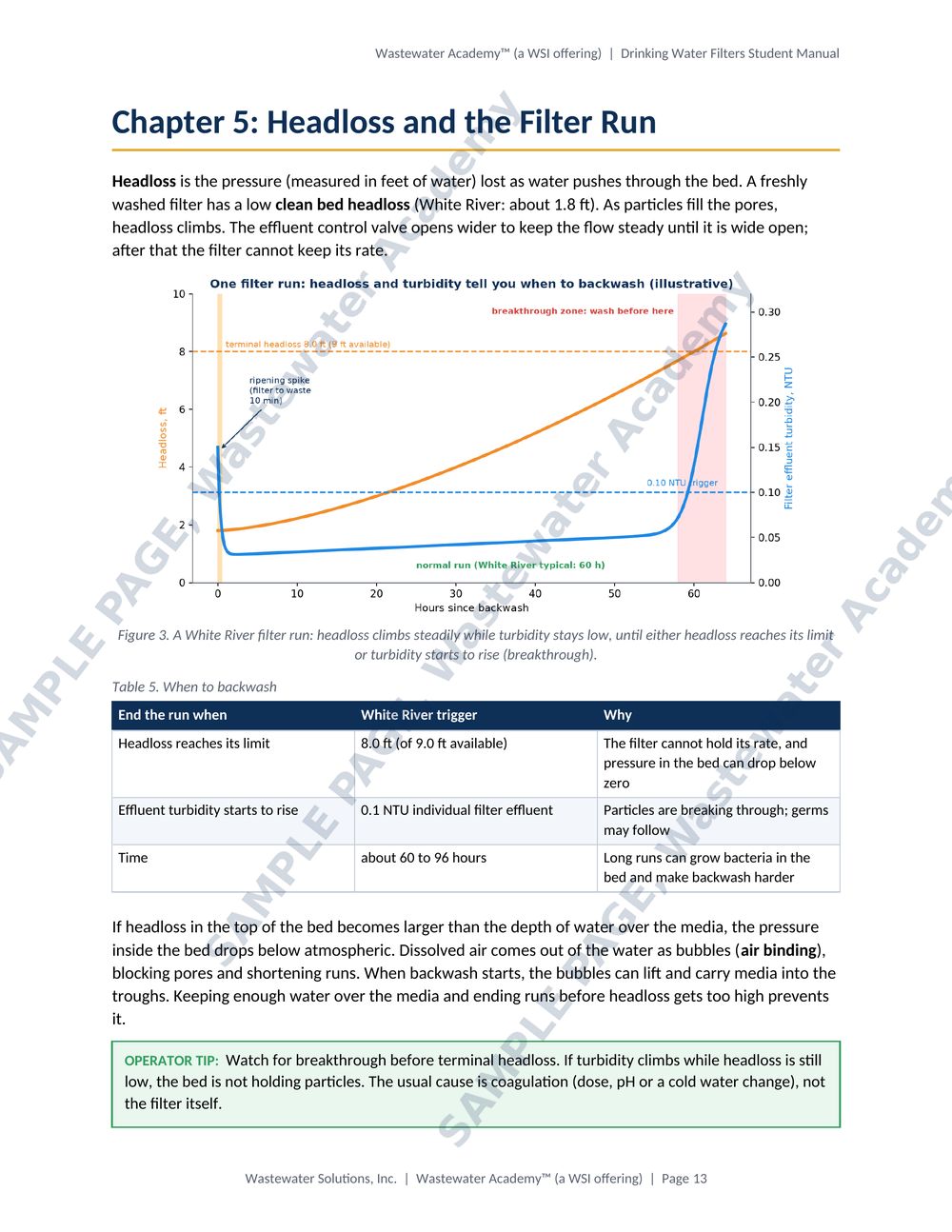
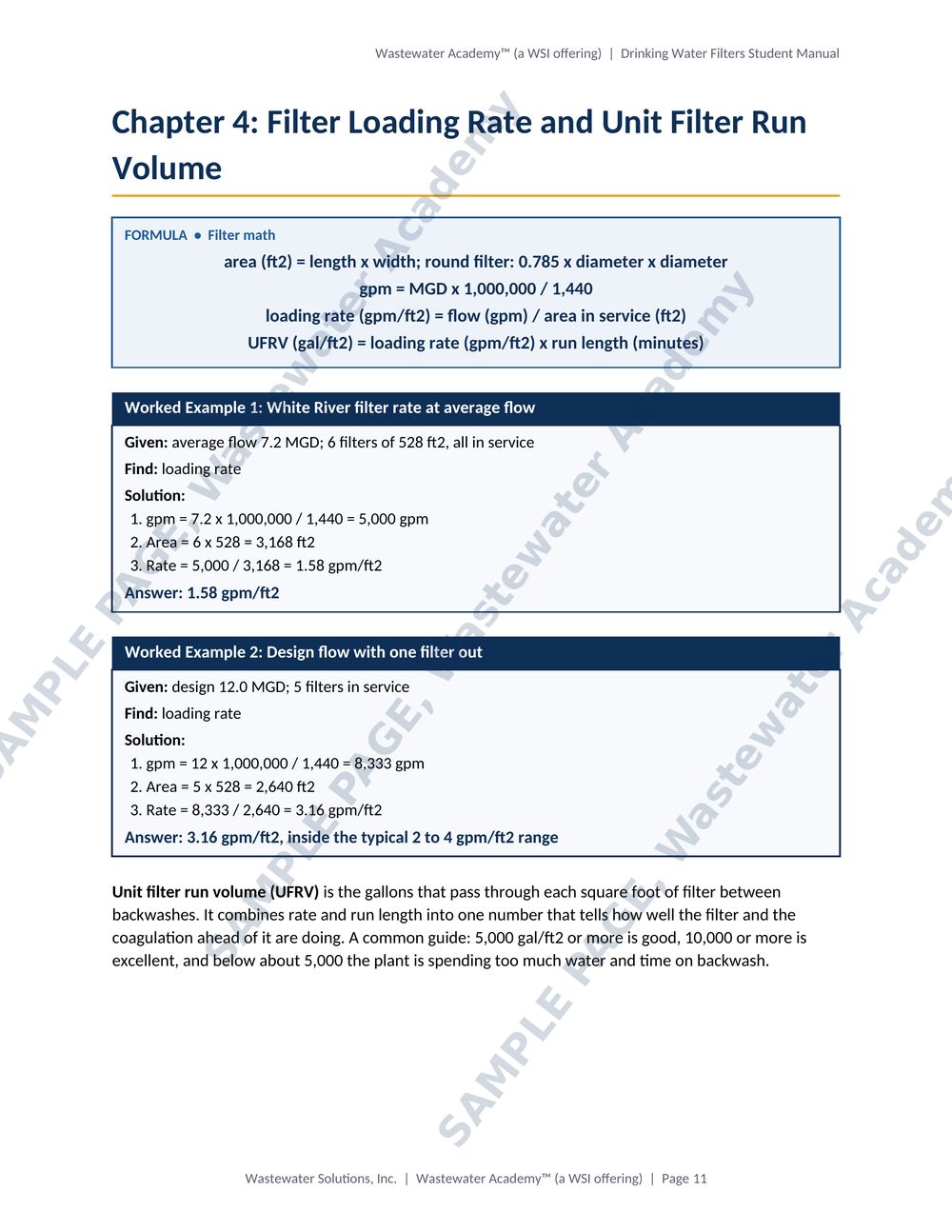
These are sample pages only. The full student manual comes with the class.
Register
2 hours, $60.
CEUs for this class are not yet approved in any state. If you need CEU credit, please wait; we'll announce approval here. Purchase is for learning only.
Need CEU credit? Ask us to tell you when CEUs are approved (tell us your state and this class), or email help@ActivatedSludge.com.
Registration is open for learning only. At checkout you confirm that you understand this class has no CEU credit yet.
After you pay, you are taken to a page where you download the student manual. The class includes a certification quiz, which opens for you after you pay, and a certificate of completion from Wastewater Academy™ when you pass it. Online access, including the manual, quiz, and certificate, lasts 90 days from purchase.
Before you buy, read our refund policy, terms of use and privacy notice.